As an Amazon Associate we earn from qualifying purchases.
If you bake rolled sponge cakes, bar cookies, or thin sheet cakes, a dedicated jelly roll pan earns its spot in the cabinet. This OXO jelly roll pan review looks at the OXO Good Grips Non-Stick Pro, a deep sheet pan made from heavy-gauge aluminized steel with a two-layer, ceramic-reinforced nonstick coating.
The short answer: it's a well-built nonstick jelly roll pan with smart design details. The catch is that its usable baking area is smaller than the name suggests, so check the internal measurements before you order.
Quick Verdict on the OXO Jelly Roll Pan
The OXO jelly roll pan is a solid pick for home bakers who want easy release and a sturdy pan for jelly rolls, bars, and cookies. The heavy-gauge steel is meant to spread heat evenly, the micro-textured surface is designed to promote airflow under your bake, and the square rolled edges give you something firm to hold.
Size is the main thing to watch. The name describes the outside of the pan, while the interior you actually bake on is smaller. The listing also doesn't state a maximum oven temperature, which is worth confirming on the packaging.
- Buy it if you want a nonstick pan for rolled cakes and bar cookies and like being able to put it in the dishwasher.
- Skip it if you need the full surface of a half sheet pan or prefer to avoid PTFE-based coatings.
What Is the OXO Good Grips Non-Stick Pro Jelly Roll Pan?
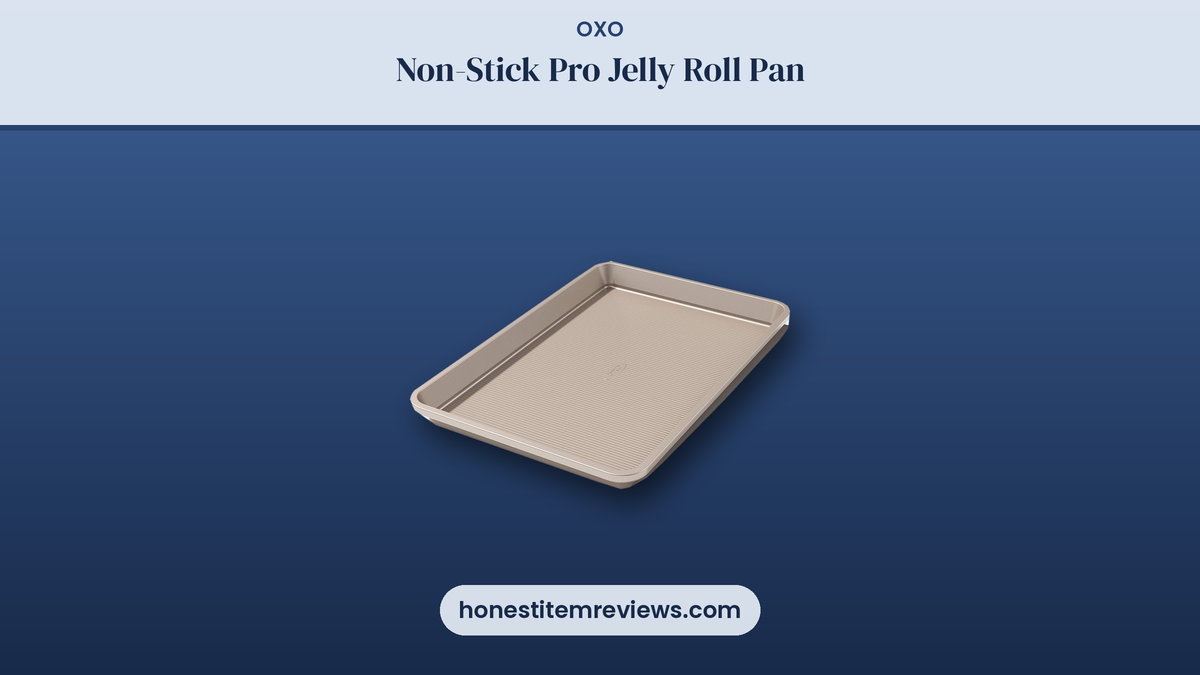
It's a rectangular, rimmed baking pan with a metallic finish. The listing says it's ideal for jelly rolls, bars, and cookies, and the product title adds sponge cakes and sheet cakes to the list.
A jelly roll pan sits between a cookie sheet and a cake pan. It has a raised rim on all four sides, so thin batter stays where you pour it, yet it's still flat and open enough for cookies and bars. That rim is the key difference from a typical cookie sheet, which often has only one raised lip or none at all.
The OXO jelly roll pan is sold on its own. According to the listing, the only included component is the pan itself, and it's described as a deep sheet pan rather than a shallow tray.
Build Quality: Aluminized Steel and a Two-Layer Nonstick Coating
Heavy-gauge aluminized steel
The body is heavy-gauge aluminized steel. Aluminized steel is steel coated with an aluminum-based layer, a common bakeware material because it pairs steel's stiffness with better resistance to rust than bare steel.
The listing says the heavy gauge promotes even heat distribution. That matters most for thin bakes like sponge sheets, where a hot spot can dry out one corner before the middle sets. Thicker metal is also generally less prone to flexing, though the listing doesn't make a specific claim about warping.
Ceramic-reinforced, two-layer coating
The coating is described as PTFE, ceramic-reinforced, two layers, and commercial grade. The listing says it provides strong nonstick food release and is scratch, stain, corrosion, and abrasion resistant.
For a jelly roll pan, release is the whole game. A sponge sheet that sticks will tear when you try to roll it, so a coating that lets go cleanly is a real advantage. Many rolled cake recipes call for parchment anyway, so you may still line the pan, but the coating gives you a backup.
One honest note: PTFE is the same family of material used in most conventional nonstick cookware. If you've decided to keep PTFE out of your kitchen, this OXO jelly roll pan isn't the right fit, and an uncoated aluminum or stainless steel pan would suit you better.
Micro-Textured Surface: Designed for Even Baking
Instead of a perfectly smooth floor, this pan has a fine textured pattern. According to the listing, the texture ensures even baking by minimizing surface contact and promoting airflow.
The idea is simple. Less direct contact between pan and food can mean more uniform browning on the bottom. We haven't measured this ourselves, so treat it as the design intent rather than a guaranteed result.
Still, it's a thoughtful touch for cookies and bars, where pale centers and dark edges are a common frustration. If you're comparing the OXO jelly roll pan with a plain, smooth-bottom pan, the texture is one of the clearer differences on paper.
Square Rolled Edges for Strength and Grip
The rim uses square rolled edges. The listing says they add strength and give you a secure grip when moving the pan into and out of the oven.
Rolled edges do two jobs. They stiffen the outer frame of the pan, and they give your oven mitts a defined lip to hold instead of a thin sheet of metal. When you're carrying a pan full of liquid batter, that firm grip is welcome.
The listing doesn't mention handles, so don't expect any. On this OXO jelly roll pan, the rolled rim is the grip.
Size and Fit: Check the Internal Dimensions First
This is the part shoppers most often miss. The size in the product name describes the pan's overall footprint, rim included. The listing separately gives its "Internal dimensions," and those are noticeably smaller. Those internal numbers are your real baking area.
Why does that matter? Jelly roll and sheet cake recipes are written for a specific pan size. Pour batter meant for a larger pan into a smaller one and you'll get a thicker layer, a longer bake, and a cake that may crack when you roll it.
Before you buy, compare the internal dimensions in the specs table with the pan size your favorite recipes call for. If they're close, you're set. If not, plan to scale the recipe down or choose a larger pan.
The listing also includes a "Capacity" entry given as a single measurement. It doesn't map neatly to volume, so lean on the internal dimensions when you're sizing recipes. On the plus side, a compact pan takes up less room in a crowded cabinet.
What You Can Make in a Nonstick Jelly Roll Pan
The listing and product title point to a handful of uses, and they cover most of what home bakers reach for this kind of pan to do:
- Jelly rolls and other rolled sponge cakes, where clean release keeps the sheet intact.
- Thin sponge layers and sheet cakes for simple frosted squares.
- Bar cookies like brownies, blondies, and lemon bars.
- Cookies, though the rim on all four sides means you'll lift them off rather than slide them off.
The listing describes the pan as oven safe but doesn't give a maximum temperature. Before using it for high-heat jobs like roasting vegetables, check the packaging for the temperature limit.
Cleaning, Care, and Warranty
The listing's care instruction is short: Dishwasher Safe. That's handy for a pan with a textured floor, since you can skip hand scrubbing.
Beyond that, the listing doesn't cover which utensils to use, whether cooking sprays are recommended, or a maximum oven temperature. Check the packaging or included instructions for those details before the first use.
On warranty, the listing says the manufacturer's warranty can be requested from customer service. It doesn't spell out the length or terms, so contact customer service if coverage is part of your decision for the OXO jelly roll pan.
Where the OXO Jelly Roll Pan Falls Short
No pan suits every kitchen. Here's where this one may let you down.
The baking area is smaller than the name suggests
The name describes outer size, not the surface you bake on. If you follow recipes written for a standard jelly roll pan or a half sheet pan, you'll likely need to adjust batter amounts or bake times.
No maximum oven temperature in the listing
The pan is listed as oven safe, but the listing gives no temperature limit. That's a real gap for a nonstick pan, so confirm it on the packaging before using it at high heat.
It uses a PTFE-based coating
The coating is what makes release easy, but some shoppers prefer to avoid PTFE altogether. If that's you, an uncoated pan is the better route, even if it means using more parchment.
OXO Jelly Roll Pan vs. Other Baking Pans
If you're not sure a jelly roll pan is what you need, here's how it compares with common alternatives.
Half sheet pan
A half sheet pan is a larger rimmed pan and the everyday workhorse in many kitchens. It handles roasting, cookies, and sheet cakes. Pick one if you want more surface area than this pan offers, but know that jelly roll recipes may need extra batter to fill it.
Cookie sheet
A cookie sheet is usually flat with one raised lip or none, so cookies slide right off. It can't hold liquid batter, though, so it won't work for jelly rolls or sheet cakes.
Baking sheet
"Baking sheet" is a catch-all term that covers both rimmed and rimless pans. Many plain baking sheets are uncoated aluminum, which suits shoppers who want to avoid nonstick coatings and don't mind lining the pan.
Insulated cookie sheet
An insulated cookie sheet uses two layers of metal with an air gap between them to slow browning on the bottom. It's useful for delicate cookies, but most are rimless and bake more slowly, so they aren't a good match for rolled cakes.
The nonstick jelly roll pan covers ground the others don't: rims for batter, a nonstick surface for release, and a size suited to rolled cakes.
Who Should Buy the OXO Jelly Roll Pan?
This pan makes the most sense for:
- Home bakers who make jelly rolls, rolled sponge cakes, or thin sheet cakes and want reliable release.
- Anyone who bakes bar cookies often and wants a rimmed, nonstick pan that can go in the dishwasher.
- Bakers with limited cabinet space who don't need a full-size half sheet pan.
You may want to look elsewhere if you need a large baking surface, follow recipes sized for bigger pans, or avoid PTFE coatings. In those cases, a half sheet pan or an uncoated baking sheet is the more practical choice.
Final Verdict: Is the OXO Jelly Roll Pan Worth Buying?
The OXO jelly roll pan gets the important details right on paper. Heavy-gauge aluminized steel for even heat, a two-layer ceramic-reinforced coating for release, a micro-textured surface for airflow, and square rolled edges for strength and grip all point to a well-thought-out pan.
Its weak spots are clear, too. The baking area is smaller than the name implies, the listing skips a maximum oven temperature, and the coating is PTFE-based. None of these is a dealbreaker for most bakers, but each is worth knowing before you click buy.
If your recipes fit its internal dimensions and you're comfortable with a nonstick coating, the OXO jelly roll pan is an easy pan to recommend for rolled cakes, bars, and cookies. Check the specs table and the packaging details, and you'll know exactly what you're getting.